
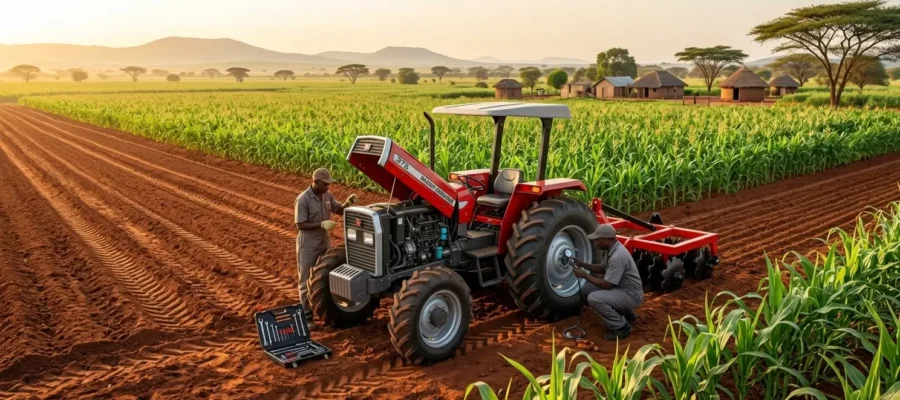
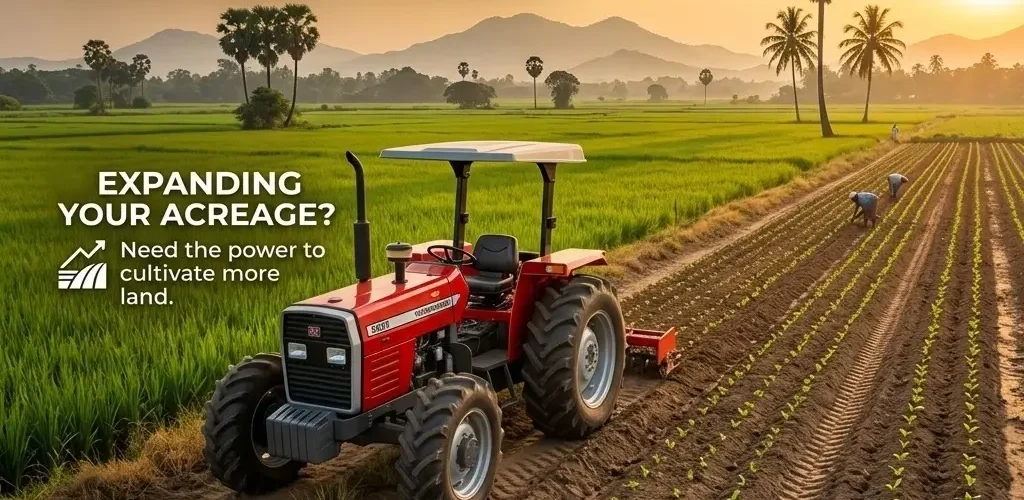
If you’re spending more hours laboring by hand than you are harvesting, relying on hired labor you can’t always count on, or watching your yields plateau despite your best efforts, it’s probably time to buy your first tractor. For many Tanzanian farmers, that moment arrives earlier than expected, and recognizing it early can save years of lost productivity.
Below are seven practical signs that your farm is ready to make the switch.
1. You’re spending too much time on manual labor
If land preparation, ploughing, or harvesting takes days instead of hours, a tractor can cut that time dramatically. Massey Ferguson tractors such as the MF-240 (50hp) and MF-260 (60hp) are built to handle these tasks efficiently, freeing up time for other farm priorities.
2. Hired labor is unreliable or expensive
Relying on seasonal workers often means dealing with inconsistent availability and rising costs. A tractor gives you control over your own schedule, so planting and harvesting happen when conditions are right, not when labor happens to be available.
3. Your farm has grown beyond manual capacity
As your land expands, manual or animal-drawn methods struggle to keep pace. A first tractor allows you to scale operations without proportionally increasing labor costs, a key step for any growing commercial or smallholder farm in Tanzania.
4. You’re losing yield due to poor timing
Delayed planting or harvesting because of slow manual processes can cost you significant yield. Mechanization allows you to work within the optimal planting and harvesting windows, something Tanzania’s Agricultural Mechanization Strategy 2026–2036 identifies as a national priority.
5. You want to use modern farm implements
Ploughs, planters, and trolleys all require a compatible power source. If you’re ready to adopt farm implements like disc ploughs or bed shape planters, you’ll need a tractor with sufficient horsepower, starting from around 50hp for most standard implements.
6. Your farming costs are rising without matching output
If input costs keep climbing while output stays flat, it’s a sign your current methods have hit their ceiling. A tractor improves efficiency per hectare, helping to lower the long-term cost per unit of output.
7. You’re ready to invest in long-term productivity
Buying your first tractor is a significant financial decision, but with financing options such as dealer plans, agricultural bank loans, and hire purchase agreements, the cost can be spread over time while your farm reaps immediate productivity gains.
Frequently Asked Questions
How much does a first tractor price in Tanzania?
Prices in Tanzania generally start at around USD 10,000 for smaller models like the MF-240 and can rise to over USD 60,000 for larger, high-horsepower tractors with added features.
What horsepower do I need for my first tractor?
Most smallholder farms in Tanzania start well with a 50-60hp tractor, such as the MF-240 or MF-260, while larger farms producing crops like sugarcane may need 75hp or more.
Can I finance my first tractor instead of paying upfront?
Yes. Tanzanian farmers can finance a tractor through authorized dealer plans, agricultural bank loans, government schemes, or hire purchase agreements, spreading the cost over time.
Related Posts


Post a Comment